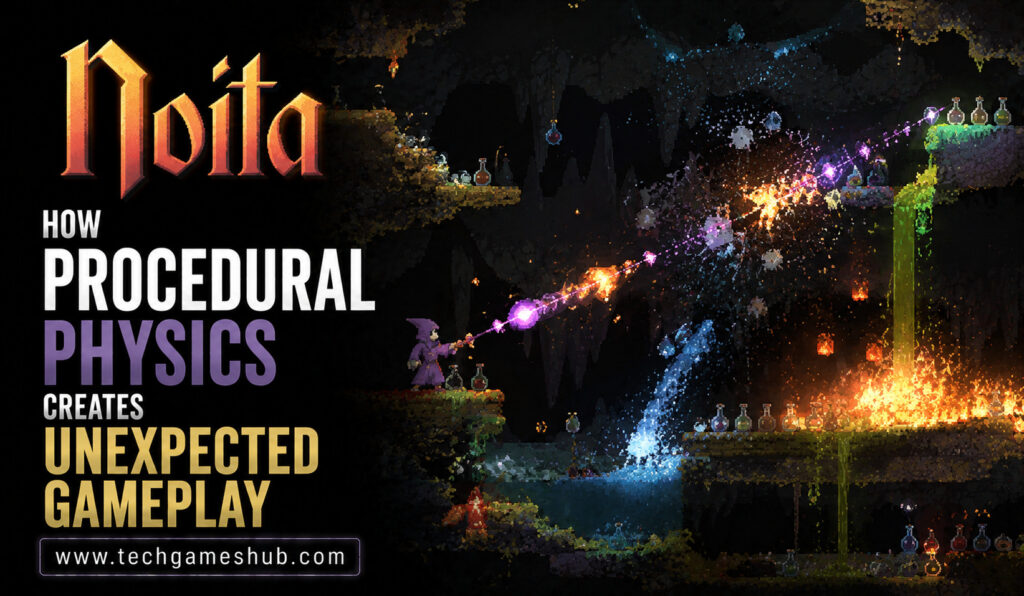
Noita is a game that turns physics into one of its most important gameplay systems. Developed by Nolla Games, this roguelike action title drops players into a dangerous world where environments, materials, spells, enemies, and destruction can interact in surprising ways.
At first, Noita may look like a traditional pixel-art action game. The player explores caves, casts spells, fights monsters, and searches for upgrades. But underneath those familiar mechanics is a highly reactive simulation where individual pixels can represent materials with physical properties.
Water can spread, fire can ignite objects, liquids can mix, gases can move, and explosions can reshape the environment. These systems can interact in unexpected combinations, producing situations that players may never have seen before.
That is what makes Noita so interesting from a technology and game-design perspective. Instead of scripting every possible event, the game provides a set of physical rules and allows them to interact.
A World Built From Simulated Materials
The most distinctive technical feature of Noita is its use of pixel-based simulation.
Many games use pixels primarily as part of their visual presentation. In Noita, however, pixels can also represent materials that behave according to different rules.
This makes the environment highly interactive.
Liquid can flow into another area. Fire can spread through flammable materials. Explosions can destroy terrain. Other substances can behave differently depending on their properties.
The player is therefore exploring a world where the environment is not completely static.
A wall is not necessarily just a wall.
A pool is not simply decoration.
The materials themselves can become part of the gameplay.
Physics Creates Emergent Gameplay
The combination of simulated materials and player actions produces emergent gameplay.
Instead of developers designing every possible interaction, they establish rules that allow different systems to influence one another.
For example, a player might accidentally create a dangerous reaction by combining a spell with an environmental material.
Another player may discover a completely different interaction.
These events can become memorable because they feel like discoveries rather than predetermined sequences.
The game essentially gives players a physics-based toolbox and asks them to learn what happens when different elements interact.
Fire Is More Than a Visual Effect
Fire demonstrates how Noita differs from many conventional games.
In a typical action game, fire may simply be an animation attached to an attack. It might damage enemies for a fixed amount and disappear after a short period.
In Noita, fire can interact with the surrounding environment.
It may spread through suitable materials and create additional hazards.
This means casting a fire-based spell is not always a simple offensive decision.
Players need to think about where they are standing and what materials surround them.
A spell that defeats an enemy could also create a dangerous situation for the player.
Liquids Behave Like Gameplay Systems
Liquids are another important part of the game’s physics.
Different substances can move through the environment and interact with objects and other materials.
This creates opportunities for both experimentation and problem-solving.
A player may use a liquid to create a temporary path, manipulate an environmental hazard, or produce an unexpected reaction.
The important part is that the liquid is not simply an item stored in an inventory.
It exists within the world.
That distinction makes the environment feel much more dynamic.
Destruction Changes the Environment
Destructible terrain is another major component of Noita’s design.
Players can often reshape their surroundings through spells and explosions.
This creates alternative routes and changes the physical structure of areas.
Instead of always searching for a door, players may discover that they can create their own route.
However, destruction can also create new dangers.
Removing part of a wall may release a liquid or expose the player to enemies. Destroying one obstacle can unintentionally create another problem.
This unpredictability is a natural consequence of the simulation.
Spells Interact With the World
The game’s wand and spell systems make the physics even more interesting.
Players can customize wands with different spells and modifiers, allowing them to experiment with unusual combinations.
A spell is therefore not just a predefined attack.
Its behavior can depend on its properties, the wand configuration, and the environment where it is used.
This creates enormous potential for experimentation.
Players can discover combinations that produce unexpected results, sometimes becoming extremely powerful and sometimes creating disasters.
The Player Can Cause Their Own Problems
One of Noita’s most entertaining qualities is that the environment can punish careless experimentation.
A player may create a powerful reaction without realizing how dangerous it will become.
An explosion can damage the player.
Fire can spread unexpectedly.
A hazardous material can turn a safe area into a dangerous one.
This means the player is not simply fighting against enemies.
They are also learning how not to accidentally destroy themselves.
The physics system therefore creates challenge through consequences rather than only through enemy difficulty.
Procedural Generation Adds More Uncertainty
The physics simulation becomes even more unpredictable because Noita also uses procedural generation.
Each run can present different environments, layouts, enemies, resources, and opportunities.
The player therefore cannot completely memorize the world.
Procedural generation determines what environment the player encounters, while the physics system determines how materials behave within it.
These technologies complement each other.
The procedural system creates variation.
The physics simulation creates interaction.
Together, they produce a large number of possible gameplay situations.
Every Run Becomes an Experiment
Because the environment can behave differently depending on circumstances, each run becomes an opportunity to experiment.
Players gradually learn what different materials do and how certain spells interact with them.
This knowledge becomes a form of progression.
A player may discover that a particular approach is useful in one situation but dangerous in another.
Over time, they become better at predicting consequences.
Yet the game continues to produce surprises because the exact combination of environment, enemies, materials, and spells changes.
Physics Encourages Creative Problem-Solving
Noita does not always require players to solve problems in a single intended way.
If a path is blocked, the player might destroy the obstacle.
If enemies are difficult to approach, the environment may provide another option.
If a material creates a hazard, players can experiment with different ways of dealing with it.
This freedom encourages creativity.
Players are not simply asking, “What solution did the developer expect?”
They are asking, “What can I make the system do?”
That is a much more open-ended approach to game design.
Unexpected Moments Become Stories
One of the biggest benefits of physics-driven gameplay is that unexpected failures can become memorable stories.
A player might accidentally trigger an explosion that destroys part of a level.
Another might create a chain reaction that eliminates several enemies.
Someone else might discover an unusual combination of spells and materials that dramatically changes a situation.
These moments are valuable because they belong to the player.
They are not necessarily cinematic scenes designed to impress everyone in exactly the same way.
They are personal gameplay stories created by interacting with the game’s systems.
Why Simulation Can Be More Powerful Than Scripting
Traditional scripted events give developers precise control over what happens.
That can be useful for storytelling and set pieces, but it also limits unpredictability.
Noita takes the opposite approach in many situations.
Instead of defining every possible outcome, the game provides systems with rules.
The player then interacts with those systems.
The result is less predictable but often more surprising.
This is an important lesson for modern game development: simulations can create experiences that would be extremely difficult to produce through conventional scripting alone.
The Technical Idea Behind the Fun
The technology behind Noita matters because it directly affects how the game feels.
The simulation is not hidden in the background.
Players see its consequences immediately.
A material flows.
A wall breaks.
A flame spreads.
A spell behaves differently in another environment.
The player can therefore understand the technology through interaction.
That makes complex simulation feel intuitive.
Players do not need to understand the underlying code to appreciate the result.
They simply learn that the world follows rules—and those rules can be manipulated.
The Future of Physics-Based Gameplay
Noita demonstrates the potential of combining procedural generation with physical simulation.
Future games could use similar ideas with increasingly sophisticated materials, environmental systems, AI characters, and dynamic worlds.
Imagine ecosystems where creatures respond to changing environments, buildings physically collapse based on structural damage, or weather systems influence gameplay in real time.
The more interconnected these systems become, the more opportunities developers have to create emergent experiences.
The challenge is making those systems understandable and enjoyable rather than simply chaotic.
Noita shows one effective way to achieve that balance.
Conclusion
Noita proves that physics can be more than a visual feature or technical experiment. It can become the foundation of gameplay.
Its simulated materials, destructible environments, spell interactions, and procedural worlds create situations that players cannot always predict.
That unpredictability is what makes the game so memorable.
Players learn the rules, experiment with the environment, and gradually become better at predicting consequences. But because the systems continue interacting in different ways, surprises remain possible.
Ultimately, Noita demonstrates the power of simulation-driven game design. By allowing physics and procedural technology to interact instead of scripting every outcome, the game creates a world where experimentation can produce discovery, creativity, chaos, and unforgettable stories.