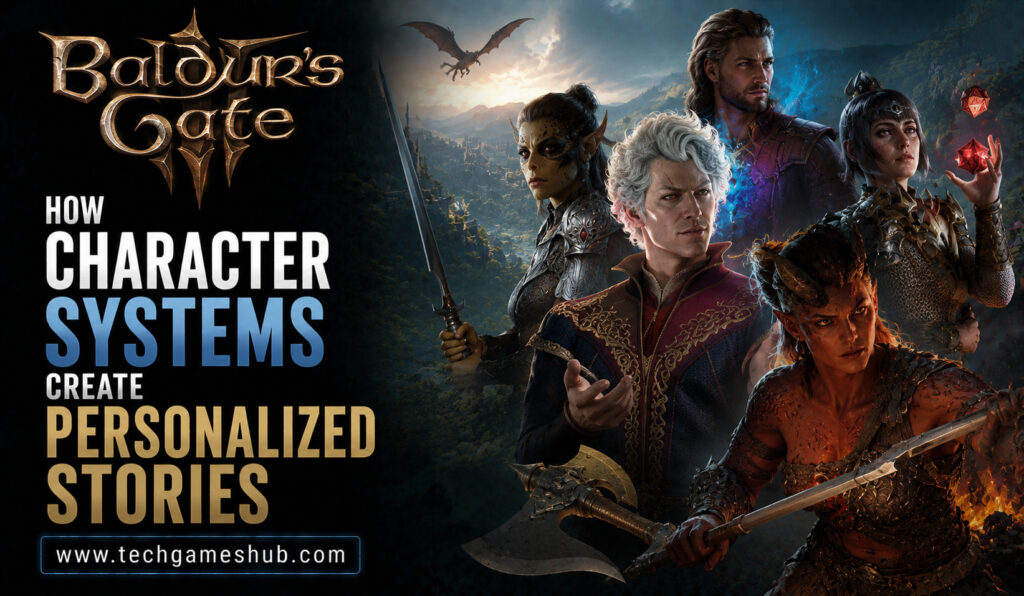
Baldur’s Gate 3 is one of the clearest examples of how modern role-playing games can use interconnected character systems to create stories that feel personal to each player. Instead of forcing everyone through exactly the same narrative, the game allows decisions, relationships, abilities, backgrounds, and companion personalities to influence how events unfold.
Developed by Larian Studios, Baldur’s Gate 3 is built around the rules of Dungeons & Dragons, but it goes far beyond simply adapting tabletop mechanics into a digital format. Its systems constantly interact with one another, creating situations where a small decision can eventually produce major consequences.
This makes the game feel less like a fixed story and more like a world that responds to the player.
Character Choice Shapes the Entire Experience
One of the first ways Baldur’s Gate 3 creates personalization is through character creation.
Players can choose different races, classes, abilities, backgrounds, and other characteristics. These choices influence combat, exploration, dialogue, and interactions throughout the adventure.
A character with a particular background may have special dialogue options. A spellcaster can solve problems using abilities that a fighter cannot. Certain races or classes can produce unique reactions from other characters.
This means character creation is not simply about appearance or combat statistics.
It establishes the player’s relationship with the world.
Companions Have Their Own Personalities
The companion system is one of the game’s most important storytelling features.
Characters such as Shadowheart, Astarion, Gale, Lae’zel, Wyll, and Karlach have their own goals, beliefs, personalities, and histories.
They are not simply party members waiting for instructions.
Companions can comment on player decisions, disagree with choices, develop relationships with one another, and react to major events.
This creates a party that feels more like a group of individuals than a collection of abilities.
A decision that one companion supports may frustrate another.
As a result, the player has to consider not only what they want to accomplish but also how their choices affect the people traveling with them.
Relationships Create Different Stories
Relationships are another major source of personalization.
Players can develop friendships or romantic relationships with certain characters, depending on their actions and interactions.
These relationships can reveal additional parts of a companion’s story.
Importantly, the relationship system is connected to the player’s broader behavior.
The way a character treats companions, handles conflicts, and makes moral decisions can influence how others respond.
This means the player does not simply select a relationship from a menu.
They develop it through gameplay.
Dialogue Systems Respond to Player Choices
Dialogue is one of the most powerful tools used by Baldur’s Gate 3 to personalize storytelling.
Players frequently receive multiple ways to respond to situations.
They can negotiate, threaten, persuade, deceive, investigate, joke, remain silent, or use class-specific abilities.
Different choices can lead to different outcomes.
The important point is that dialogue is often connected to the player’s character rather than being identical for everyone.
A character’s background, abilities, race, class, previous actions, and relationships can all influence available options.
This creates the feeling that the protagonist genuinely belongs in the world.
Dice Rolls Add Uncertainty
The game’s use of dice rolls introduces another layer of unpredictability.
Many important actions depend on ability checks.
A player may have an excellent plan but fail because of an unlucky roll.
Alternatively, an unexpected success can open an entirely different path.
This is especially interesting because the game does not always treat failure as a dead end.
A failed check can create a new situation rather than simply forcing the player to reload.
The result is storytelling shaped by both choice and chance.
Failure Can Create Unique Narratives
Traditional games often treat failure as something that should be avoided at all costs.
Baldur’s Gate 3 frequently allows failure to become part of the story.
A failed conversation, missed opportunity, or unsuccessful ability check can lead to consequences that the player must deal with.
This creates stories that feel less predictable.
Two players can make similar decisions but experience different outcomes because of different character builds or dice results.
The game therefore supports a large number of possible personal narratives without requiring every player to follow a completely separate campaign.
Companions React to Player Behavior
Companion reactions help reinforce the idea that the world is paying attention.
Characters may approve or disapprove of decisions based on their personalities and values.
Over time, these reactions help establish the player’s relationship with each companion.
A player who repeatedly makes decisions that conflict with a companion’s beliefs may create tension.
Another player may build a stronger relationship by consistently supporting that character’s goals.
These differences make the party feel responsive.
Character Builds Influence Problem Solving
Character systems also affect how players solve problems outside combat.
Different classes provide different abilities that can be useful during exploration and dialogue.
A character with strong charisma may have more opportunities to persuade others. A character skilled in stealth may approach a situation differently. A powerful spellcaster can use magic to overcome obstacles that another character might need to solve through physical interaction.
This means there is rarely only one solution.
The player’s character build becomes part of the storytelling system.
The World Reacts to Player Actions
Personalized storytelling becomes much more effective when the environment also responds to decisions.
Players can interact with characters, objects, factions, creatures, and locations in numerous ways.
Their choices can influence later events.
Helping one group may create problems with another. Supporting a companion can affect relationships elsewhere. Choosing violence can close certain opportunities while opening others.
These connections make the world feel reactive.
The story is not simply something the player watches.
It is something the player helps create.
Moral Choices Are Not Always Simple
Another reason Baldur’s Gate 3 produces personalized stories is that many decisions are not clearly divided into good and evil.
Players often encounter situations where every option has advantages and disadvantages.
Helping one character might harm someone else.
Showing mercy may create a future problem.
Taking a selfish decision may produce an unexpected benefit.
This complexity allows players to develop their own interpretation of their character.
Rather than selecting from a simple morality meter, they make decisions based on their own priorities.
The Game Encourages Experimentation
Because so many systems interact, Baldur’s Gate 3 encourages players to experiment.
Players can try unusual dialogue options, different abilities, alternative routes, environmental interactions, or unexpected combat strategies.
The game often rewards creative thinking.
This makes the world feel more flexible than a traditional linear RPG.
Players gradually learn that the game may allow solutions they did not expect.
That uncertainty is a major part of the fun.
Emergent Storytelling Comes From System Interaction
The strongest personalized moments often emerge from several systems interacting at once.
A character may have a particular ability, relationship, background, and goal. The player then makes a decision, rolls for an ability check, and produces an unexpected outcome.
The resulting event may not feel like a prewritten story sequence.
It feels like something that happened because of the player’s specific circumstances.
This is the essence of emergent storytelling.
Developers create the rules and possibilities, while the player creates the exact sequence of events.
Why the Characters Feel So Dynamic
The characters in Baldur’s Gate 3 feel dynamic because they are connected to multiple systems.
They have personalities, histories, goals, relationships, reactions, and progression.
A companion is therefore not just a combat unit.
They can become a source of conflict, friendship, romance, humor, information, and narrative development.
This gives players reasons to care about what happens to them.
The emotional impact of the story comes partly from the fact that these relationships are influenced by the player’s own behavior.
A New Standard for Interactive RPGs
Baldur’s Gate 3 demonstrates what can happen when character systems are deeply integrated with storytelling.
Instead of separating combat, dialogue, exploration, and relationships into independent mechanics, the game allows them to influence one another.
This creates a world where the player’s character is not simply following a predetermined storyline.
The player is shaping the circumstances under which that storyline develops.
Future RPGs can build on this approach by creating even more reactive companions, adaptive dialogue, and persistent character relationships.
Conclusion
Baldur’s Gate 3 demonstrates how interconnected character systems can transform a traditional RPG into a highly personalized storytelling experience.
Character creation influences interactions. Companions respond to decisions. Relationships develop through gameplay. Dice rolls create uncertainty. Different abilities provide different solutions, while player actions can change future events.
The result is a game where two players can experience the same broad adventure but remember completely different stories.
That is the real strength of its design. Baldur’s Gate 3 does not simply give players a story to follow—it gives them a flexible system of characters, choices, relationships, and consequences that allows each journey to become its own story.