
The Stanley Parable is one of the most creative examples of interactive storytelling in modern video games. Instead of focusing on combat, progression, or traditional challenges, the game revolves around a much simpler idea: what happens when the player refuses to do what the game expects?
You play as Stanley, an office worker who discovers that everyone around him has mysteriously disappeared. A narrator begins describing what Stanley is doing and what he should do next. The player, however, can choose whether to follow those instructions.
That simple conflict between player choice and narration creates an experience where game systems constantly respond to decisions. Doors, rooms, dialogue, endings, and even the narrator’s behavior can change depending on what the player does.
Rather than using artificial intelligence in the conventional sense, The Stanley Parable demonstrates how carefully designed game systems can create the feeling of a world that understands and reacts to the player.
A Game Built Around Player Choice
Most games give players choices, but those choices usually exist within clearly defined objectives.
The Stanley Parable makes choice itself the central mechanic.
At the beginning, the narrator describes Stanley’s actions and suggests where he should go. The player can follow those instructions or deliberately do something different.
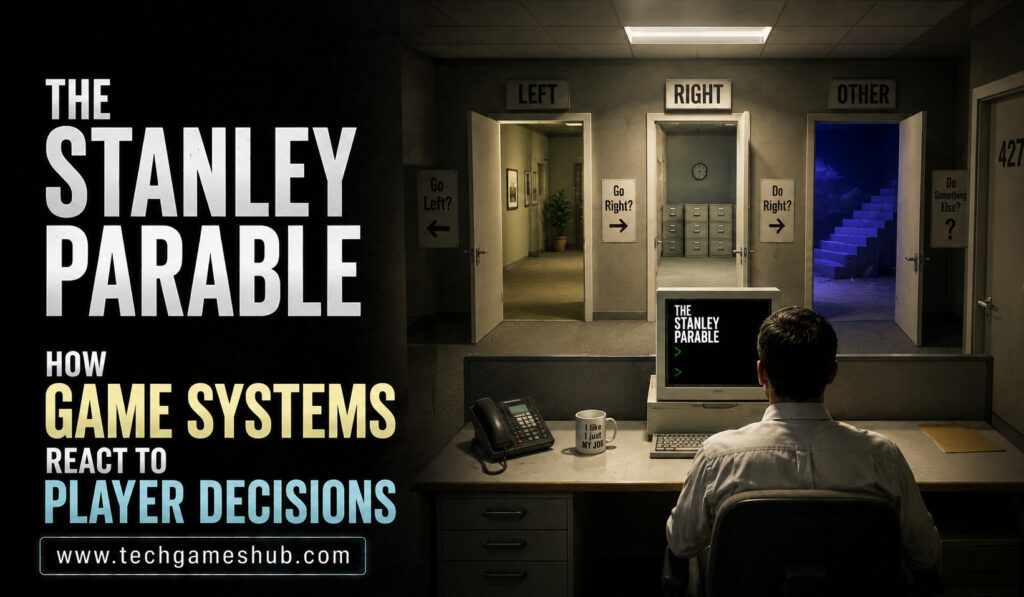
For example, the narrator may expect Stanley to enter one particular door. The player can choose the other door instead.
That decision immediately creates a conflict between the player’s intention and the game’s expected path.
This is where the game’s reactive systems become interesting.
The Narrator Reacts to Player Decisions
The narrator is one of the most important systems in The Stanley Parable.
His dialogue changes depending on what the player does. If the player follows his instructions, the story can proceed in one direction. If the player disobeys, the narrator may acknowledge the decision and respond accordingly.
The effect is unusual because the player begins to feel as though the game is watching their behavior.
The narrator is not simply delivering a fixed story. His dialogue is connected to the player’s choices.
This creates the illusion of a highly responsive game world.
Branching Paths Create Different Experiences
The game uses branching paths to produce different outcomes.
A simple decision, such as choosing between two doors, can send the player toward a completely different sequence of events.
These branches are not merely cosmetic. They can change the dialogue, environments, objectives, and eventual ending.
This structure demonstrates one of the most effective ways to make player decisions feel meaningful.
The game does not need thousands of possible choices. Instead, it makes a relatively small number of decisions matter dramatically.
The Game Understands Disobedience
One of the most entertaining aspects of The Stanley Parable is the way it handles players who intentionally try to break the expected rules.
Players quickly realize that they can experiment.
What happens if they refuse to enter a room? What if they go somewhere they were not supposed to? What if they repeatedly ignore the narrator?
The game anticipates many of these possibilities.
This is not necessarily artificial intelligence in the modern machine-learning sense. It is carefully designed conditional logic.
The developers created systems that recognize specific player behaviors and respond with different dialogue, events, or consequences.
Yet from the player’s perspective, the result can feel surprisingly intelligent.
Conditional Logic Creates the Illusion of Intelligence
The game demonstrates an important principle of interactive design: a system does not have to be genuinely intelligent to appear responsive.
Developers can define conditions such as:
- If the player chooses one path, trigger event A.
- If the player chooses another, trigger event B.
- If the player ignores the expected objective, change the narrator’s dialogue.
- If the player repeats certain actions, activate another sequence.
These rules can create complex-looking reactions when combined effectively.
The Stanley Parable uses this approach as part of its storytelling rather than hiding it.
In fact, the game often makes the player think about the systems behind the experience.
Breaking the Fourth Wall
The game’s reactive design works closely with its fourth-wall-breaking humor.
The narrator does not behave as though the player is invisible.
He comments on choices, mistakes, disobedience, and unexpected actions. This makes the relationship between player and game unusually direct.
Instead of pretending that the player is simply controlling Stanley, the game acknowledges that there is a person making decisions outside the fictional world.
That creates one of the game’s central themes: who is actually in control?
Is Stanley making decisions?
Is the player making decisions?
Or is the narrator manipulating both?
The reactive game systems make these questions part of the experience.
Player Expectations Become a Gameplay Mechanic
Most games rely on players understanding common video game conventions.
Players expect doors to lead somewhere. They expect objectives to have logical solutions. They expect following instructions to advance the story.
The Stanley Parable uses those expectations against the player.
The game can encourage a particular action and then make the player wonder what will happen if they refuse.
This creates a unique form of gameplay where curiosity becomes more important than traditional progression.
Players begin testing the boundaries of the system.
Repetition Reveals More Possibilities
Another important feature is repetition.
The player can experience different versions of Stanley’s story and discover that previous actions have consequences.
Returning to the beginning does not necessarily mean the experience is identical.
Different decisions can reveal new dialogue, locations, jokes, and endings.
This encourages players to experiment.
The game essentially turns replaying into a form of investigation. Players are trying to understand how the system reacts to different inputs.
The Narrator and Player Become Opponents
The relationship between the player and narrator can sometimes resemble a competition.
The narrator wants the story to follow a particular direction. The player may deliberately resist.
This creates a strange kind of conflict without combat.
The player’s weapon is choice.
The narrator’s weapon is the ability to adapt the story.
That relationship is one of the reasons the game feels so interactive. The player is not simply moving through a story. They are challenging the storytelling system itself.
Designed Reactions Can Feel Surprisingly Personal
When a game responds directly to something the player intentionally did, the reaction can feel personal even if it was fully programmed in advance.
This is particularly effective when the player performs an unusual action.
If the game responds to behavior that players assumed would be ignored, they may feel that they have discovered something special.
The Stanley Parable repeatedly creates these moments.
The player begins wondering how far the developers anticipated their behavior.
That uncertainty makes experimentation rewarding.
Game Design Instead of Traditional AI
It is important to distinguish The Stanley Parable’s reactive systems from traditional artificial intelligence.
The game is not primarily using AI to create autonomous characters that learn independently.
Instead, its responsiveness comes from branching narrative structures, conditional events, scripting, environmental design, and carefully planned dialogue.
However, the result demonstrates a broader concept relevant to AI and game development.
Players do not necessarily care how a system produces a reaction. They care whether the world responds meaningfully to what they do.
That principle is increasingly important as developers explore more advanced interactive systems.
Lessons for Future Interactive Games
The Stanley Parable demonstrates that player agency can be created through relatively simple systems when those systems are designed carefully.
A future game could combine traditional branching logic with more advanced AI capable of remembering player behavior, adapting dialogue, or changing objectives dynamically.
Instead of selecting from a small number of predetermined paths, players could potentially interact with game worlds that continuously adjust to their habits.
The challenge would be maintaining narrative quality while allowing greater freedom.
The Stanley Parable shows why that challenge is worth exploring.
Conclusion
The Stanley Parable proves that a game can feel highly intelligent without relying on conventional enemy AI or complex simulations.
Its greatest strength comes from the relationship between player decisions and reactive game systems. Choices change dialogue, paths, events, and endings, while the narrator constantly challenges the player’s expectations.
The game turns conditional logic into a storytelling tool.
More importantly, it demonstrates that meaningful interaction is not necessarily about giving players unlimited freedom. Sometimes, carefully designed reactions to a small number of choices can create a much stronger sense of agency.
By making the player question instructions, test boundaries, and experiment with the world, The Stanley Parable transforms simple game mechanics into an exploration of choice, control, and interactive storytelling.