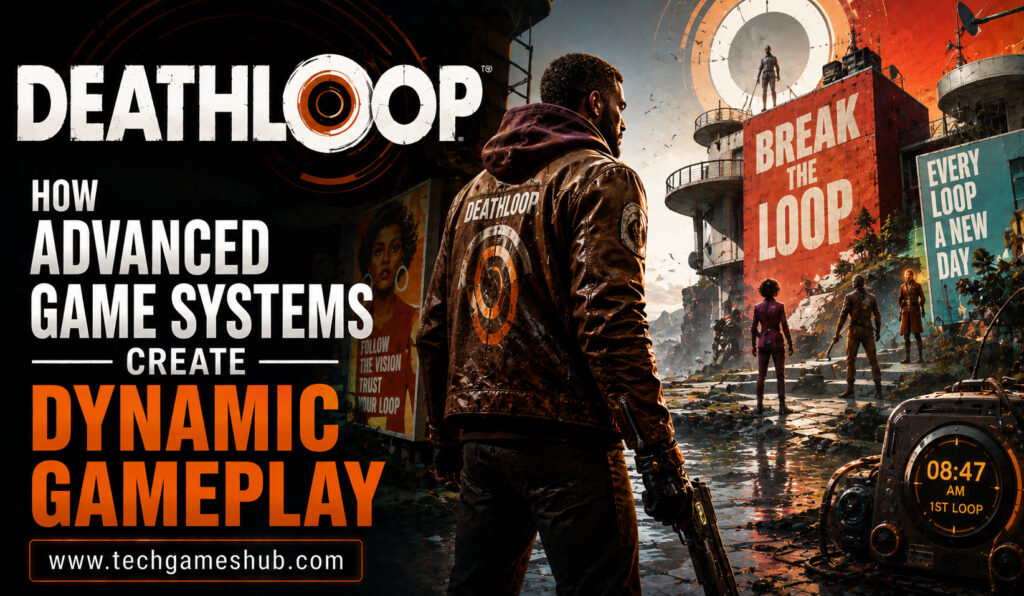
Modern games increasingly rely on interconnected systems to create experiences that feel unpredictable and responsive. Deathloop, developed by Arkane Studios, is a strong example of this approach. The game combines time-loop mechanics, intelligent enemy behavior, immersive level design, supernatural abilities, weapons, and player progression to create a gameplay experience where experimentation is central to success.
Set on the mysterious island of Blackreef, Deathloop follows Colt, an assassin trapped in a repeating time loop. Every day eventually resets, but the player’s knowledge carries forward. This unusual structure transforms the traditional action game into a strategic puzzle where learning, experimentation, and system mastery are more important than simply becoming stronger.
The Time Loop Changes the Rules
The most important system in Deathloop is its time loop.
Colt repeatedly experiences the same day, with Blackreef divided into different locations and times. When the loop resets, the island’s inhabitants and events return to their previous states.
At first, this may seem repetitive.
However, the game uses repetition as a learning tool.
Players gradually discover where important characters go, what activities happen at different times, and which opportunities can be combined.
The loop effectively turns the entire island into a puzzle.
Knowledge Becomes a Form of Progression
Traditional games often reward players by making their characters stronger through levels, equipment, or abilities.
Deathloop uses another form of progression: knowledge.
After repeating the same day several times, players understand the environment better.
They may discover where a target appears, identify a useful shortcut, learn how an enemy behaves, or uncover information that changes the way a mission can be approached.
This creates a unique relationship between player and game systems.
The character may physically return to the beginning of the loop, but the player does not.
Experience and knowledge remain.
Dynamic Gameplay Through Interconnected Systems
Deathloop’s gameplay becomes particularly interesting because its systems interact.
Characters follow schedules. Locations change depending on the time of day. Security systems affect infiltration. Weapons and abilities provide different approaches.
These elements combine to create opportunities that may not be obvious during a first attempt.
A player might discover that two important characters can be influenced during the same period, making it possible to create a more efficient plan.
The game rewards players who recognize connections between seemingly separate events.
AI Makes Encounters Less Predictable
Enemy AI plays an important role in keeping combat and infiltration interesting.
Guards patrol areas, respond to disturbances, investigate suspicious activity, and engage Colt when he is discovered.
This means that stealth is not always about memorizing fixed patterns.
Players need to pay attention to how enemies react.
A carefully planned infiltration can change quickly if a guard detects something unusual.
That uncertainty encourages improvisation and makes individual encounters feel more dynamic.
Julianna Adds a Unique AI and Multiplayer Element
Julianna is one of the most distinctive systems in Deathloop.
She can invade Colt’s loop and attempt to stop him from completing his objectives.
Depending on the mode and circumstances, Julianna can be controlled by another player or by the game’s AI.
This creates an additional layer of unpredictability.
Colt may enter an area expecting to deal with predictable enemies, only to discover that Julianna is actively hunting him.
The resulting encounters can become tense because the player must consider both the normal environment and a highly capable opposing character.
The Loop Creates Strategic Freedom
Because Blackreef follows a repeating schedule, players can gradually experiment with different approaches.
Instead of rushing toward an objective, they can investigate the environment and collect information.
This creates a slower strategic layer beneath the game’s action.
Players might spend one loop testing an ability, another observing a target, and another attempting a more ambitious plan.
The game therefore encourages experimentation rather than demanding immediate mastery.
Weapons and Abilities Expand Player Options
Deathloop provides a variety of weapons and supernatural abilities that allow players to approach encounters in different ways.
Some abilities can help with movement, while others provide offensive or defensive advantages.
Weapons also vary in their characteristics, allowing players to develop preferred loadouts.
This flexibility supports the game’s experimental design.
A player can attempt to solve a situation through stealth, direct combat, mobility, environmental manipulation, or a combination of techniques.
The important part is that these tools interact with the game’s other systems.
Slabs Change How Players Approach the World
The game’s supernatural abilities, known as Slabs, are particularly important.
They provide powers that can dramatically change how Colt interacts with enemies and environments.
Some abilities can help him move quickly, while others influence enemies or provide defensive advantages.
These abilities can turn difficult encounters into opportunities.
A heavily guarded area may be approached differently once the player has learned how a particular Slab can be used.
This creates a strong connection between progression and experimentation.
Residuum Solves the Problem of Permanent Progress
The time loop creates an interesting progression challenge.
If everything resets, how can players maintain useful equipment?
Deathloop addresses this through Residuum, a resource that allows certain weapons, Slabs, and upgrades to be retained between loops.
This system creates a balance between repetition and progression.
Players still need to repeat the day, but they can gradually build a more effective collection of equipment.
The result is a progression system that supports experimentation without eliminating the importance of the loop.
The World Becomes a Puzzle Box
Blackreef is designed to reward careful observation.
Different districts contain different opportunities, and the time of day can change what happens there.
Players gradually learn how the island’s systems connect.
A building that seems unimportant early in the game may later become central to a larger plan.
This design encourages players to revisit locations with new knowledge.
Instead of feeling like repeated content, returning to the same places can reveal new possibilities.
Environmental Design Supports Dynamic Gameplay
Deathloop’s environments contain numerous routes, vertical spaces, hidden areas, security systems, and interactive elements.
This gives players multiple ways to approach objectives.
A player might move across rooftops, sneak through an interior route, use an ability to reach a difficult location, or simply fight through a heavily guarded area.
The environment therefore acts as a toolkit.
Its design complements the game’s systems by allowing players to experiment with different solutions.
Failure Becomes Part of the Strategy
Deathloop treats failure differently from many traditional action games.
Dying or failing does not necessarily mean that the player has wasted the entire attempt.
Instead, failure can provide information.
Players may discover an enemy position, learn a target’s routine, find a new route, or understand a mechanic that was previously unclear.
This makes experimentation less frustrating.
The player can treat each loop as an opportunity to learn.
The Role of Time in Tactical Planning
Time is not simply a narrative device in Deathloop.
It is a strategic resource.
Different events occur during different periods, meaning players must decide how to spend each section of the day.
A player may prioritize gathering information in the morning and attempt a more ambitious plan later.
This creates a sense of urgency without requiring a traditional countdown.
The player knows that the day will eventually end, so every decision has a strategic cost.
Dynamic Systems Create Emergent Moments
One of Deathloop’s greatest strengths is its ability to produce moments that feel unscripted.
A stealth plan may become a chaotic firefight. An unexpected enemy may appear. Julianna may invade at the worst possible moment. A carefully prepared route may suddenly become unusable.
These moments emerge from the interaction of systems.
Rather than every dramatic event being fully scripted, the game’s mechanics can create surprising situations naturally.
This is one of the main reasons Deathloop feels dynamic.
How Deathloop Balances Complexity
With so many interconnected systems, Deathloop could easily become overwhelming.
However, the game gradually introduces its mechanics.
Players first learn the basic structure of the loop, then discover targets, locations, abilities, schedules, and progression systems.
This creates a learning process that mirrors the story.
As Colt learns more about Blackreef, the player also develops a better understanding of how the game’s systems work.
The Future of System-Driven Gameplay
Deathloop demonstrates the potential of advanced game systems to create experiences that feel different from traditional scripted adventures.
Future games could use more sophisticated AI, dynamic schedules, procedural environments, adaptive missions, and player-driven narratives.
Instead of designing every encounter manually, developers could create interconnected systems that generate unexpected situations.
This approach could make games more replayable because players would encounter different outcomes based on their choices and behavior.
Conclusion
Deathloop demonstrates how advanced game systems can create dynamic and highly replayable gameplay. Its time-loop structure turns repetition into progression, while AI behavior, player abilities, weapons, environmental design, schedules, and multiplayer invasions interact to produce unpredictable situations.
The game’s most innovative feature is the way it transforms knowledge into a strategic advantage. Players gradually understand Blackreef and use that information to create better plans.
Rather than simply asking players to defeat enemies, Deathloop encourages them to experiment, observe, adapt, and manipulate interconnected systems.
Ultimately, the game shows that dynamic gameplay does not always require enormous maps or endless content. Carefully designed systems that interact with one another can create a world where every loop provides new information, every failure teaches something, and every successful plan feels genuinely earned.